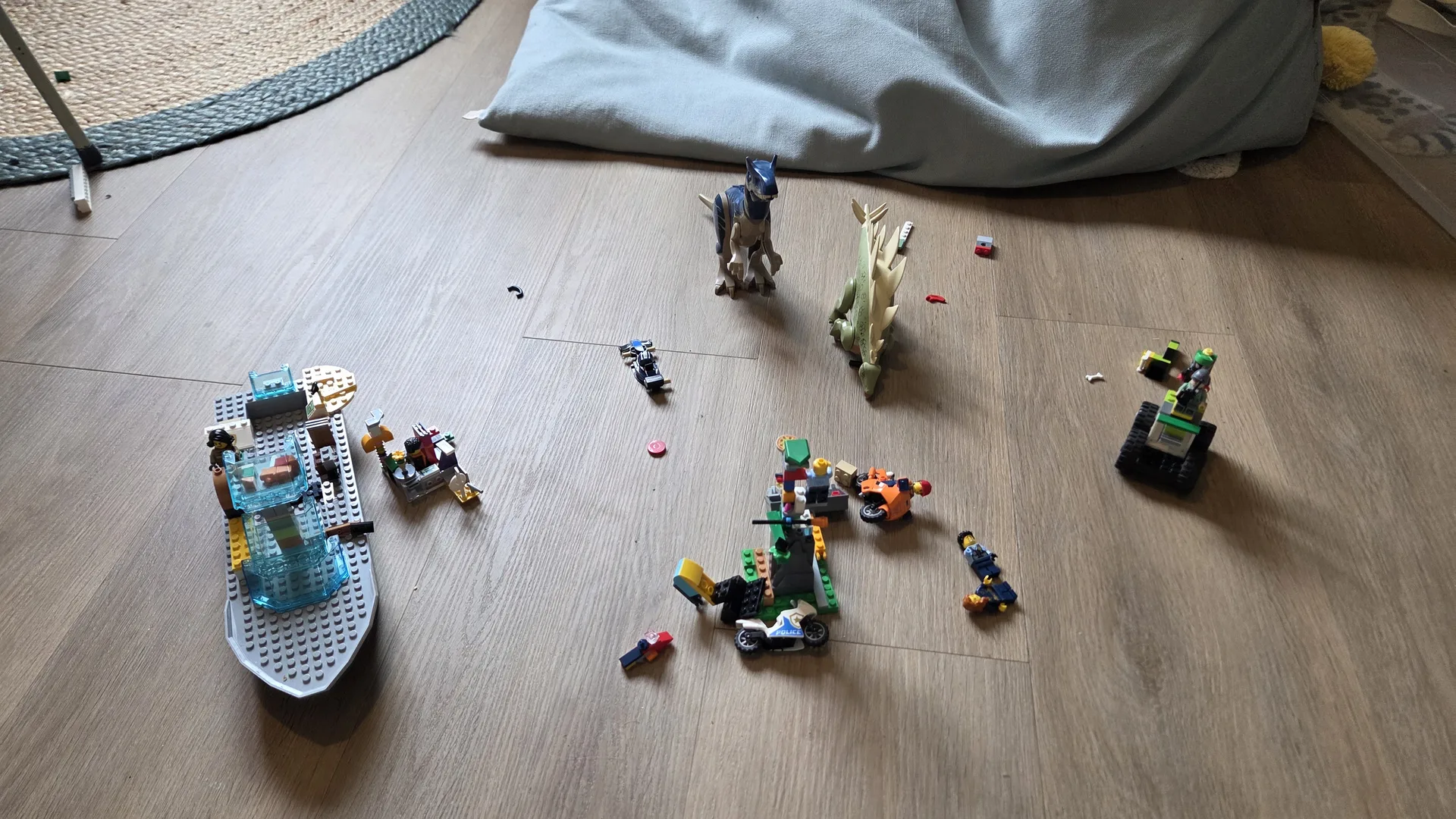
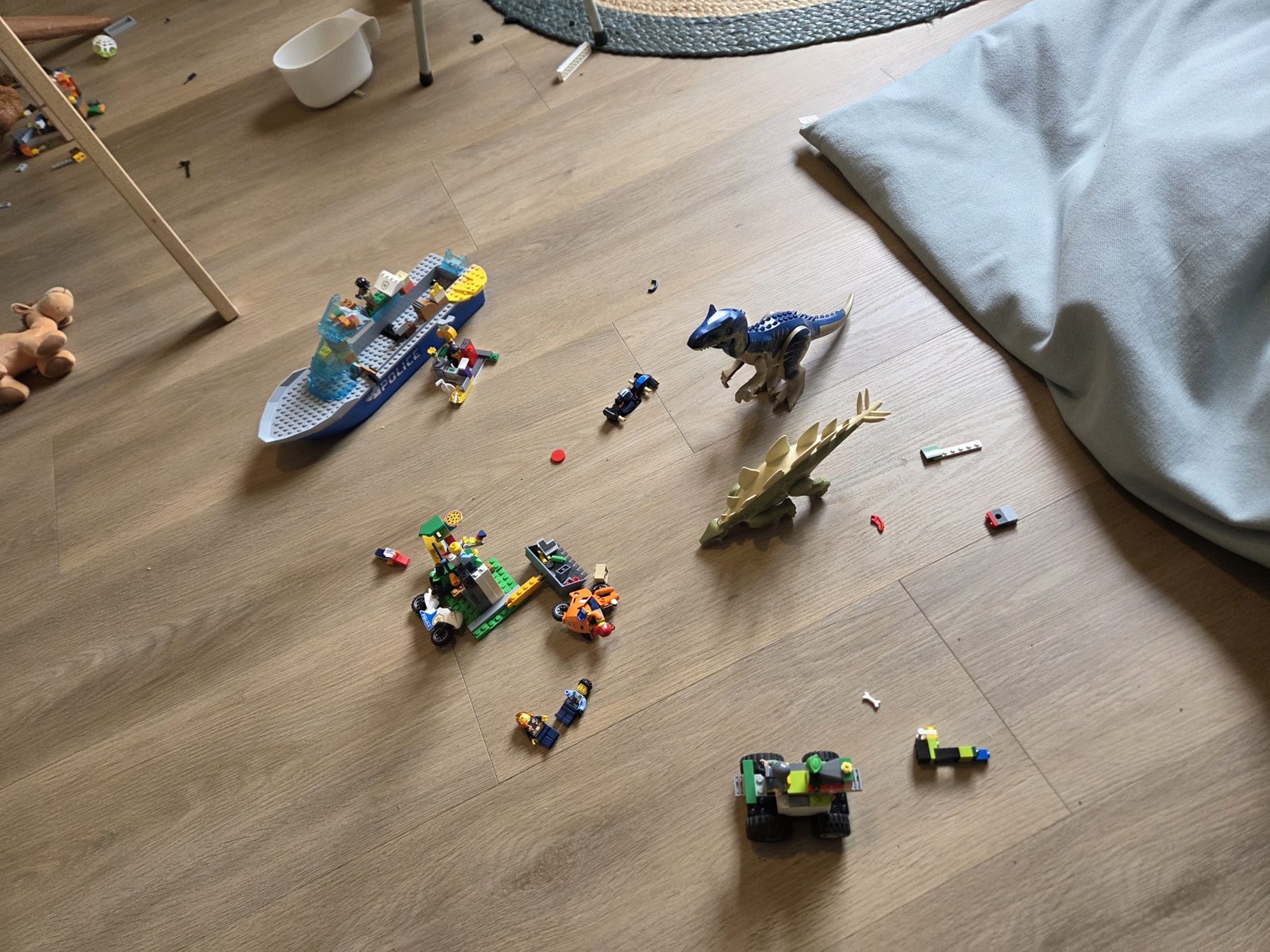
On 21 August my five-year-old son built a scene on the living room floor: a blue dino, a stegosaurus, a police boat, a quad with a ranger and a few loose Lego bones. He told the story himself. The dino has escaped, the police are after it, and along the way it collects bones. I took three photos, from three angles.
By the end of that afternoon he was playing it as a game on the tablet. He still plays it, regularly. You can play it here. The game itself is in Dutch.
This piece is for anyone who builds with AI, or wants to. It shows how the making went, step by step, and what it cost.
What I already had
I build with Claude Code. That is an AI that writes code with me on my laptop: I say in plain language what I want, it writes and tests it, I look and steer. I also had a kids' hub, a tablet app where my children find their games and videos, and an earlier racing game whose controls had already been tested on the tablet. The dino game is built on that base.
Step 1: let the child build, and take photos
My first message to Claude that afternoon was the longest of the whole project, 105 words. The key part was in it: use the three photos as the base, and make a transition from photo to game graphics, so my son can see that he came up with the core.
That became the opening of every level. You tap the photo, a circle grows from your finger, and inside that circle his Lego turns into pixel art. Three photos became three levels. The photo is the scenery itself, so that cost no image generation credits.
What did cost money: cutting the figures out of the photo. That is how the dino, the stegosaurus, the boat, the quad and his actual Lego bone became the sprites. That was 15 credits at Freepik.
Step 2: choose from options, not from a blank page
I first asked Claude for proposals. It came back with three: a treasure hunt, a running adventure or a care-for-your-pet game. I picked the running adventure. After that the AI worked on its own for over an hour, from image processing to controls.
At 15:00 I tested the first version and it got stuck on the photo. The cause was that I had opened the file directly on my laptop, so the browser blocked the pixel effect. At 15:08 the working version was live on the tablet.
Step 3: let him play, and listen
That evening his feedback came in, and I passed it on word for word: "the dinos have to walk. And he can already do Paw Patrol on the PS4. So it can be a bit more advanced."
Claude proposed options again. I picked a side view in which the dino runs and jumps, with the police boat chasing it in the background. The walking motion came from one image by Nano Banana 2 with four poses per dino, for 75 credits. The controls became those of a game console: left thumb jumps, right thumb roars. From my go-ahead to the live version took eight minutes.
Step 4: another round, when he is ready for it
Four weeks later, on 17 September, we did a third round. After every five bones the dino briefly turns into a golden mega-dino that stomps obstacles away. The jumps got more feel: the dino squashes when it lands, a puff of dust appears, and the bones fly to the counter. From my choice to live took five minutes.
That evening I asked: can the roar become a real dino roar? Claude had a two-second sound made with ElevenLabs via Freepik, for 10 credits. For the mega-dino the same recording plays slower, so it sounds heavier.
A day later I tested on my phone. The game worked, but the instructions for jumping and roaring were tiny and gone again quickly. The game draws on a layer at a third of the screen resolution, for the pixel look, and text on that layer becomes unreadable on a phone. The instructions now sit in a layer above it, large and on screen for longer.
The bill
I counted the time afterwards from the conversations with Claude and the moments a version went live. Only the dino game counts, not the racing game it builds on.
- Building the Lego: about an hour, by my son.
- My time at the screen: about 2 hours and 45 minutes, spread over three days. Of that, 81 minutes was one long build run in which I had nothing to do. Without that run I was busy for about 1 hour and 25 minutes.
- What I typed: 26 messages, about 350 words in total.
- Time the AI worked: about 2 hours and 20 minutes.
- Money: 100 credits at Freepik for the figures, the walking motion and the roar. Claude fell within my subscription.
What is not in that count: playing and testing with him. That happened in the hours between the rounds, and I did not track it.
The biggest step in the game, from a standing to a running dino, came from him.
Here are photos of something my child built or drew, plus the story they told with it. Don't build anything yet. First ask me five questions: who is the hero, what do they want, what is in the way, what do you collect, and what should happen when things go wrong. Then make three proposals for a simple tablet game, each with a short explanation of how my child controls it. Keep the photos themselves as the scenery, so my child sees their own work back.